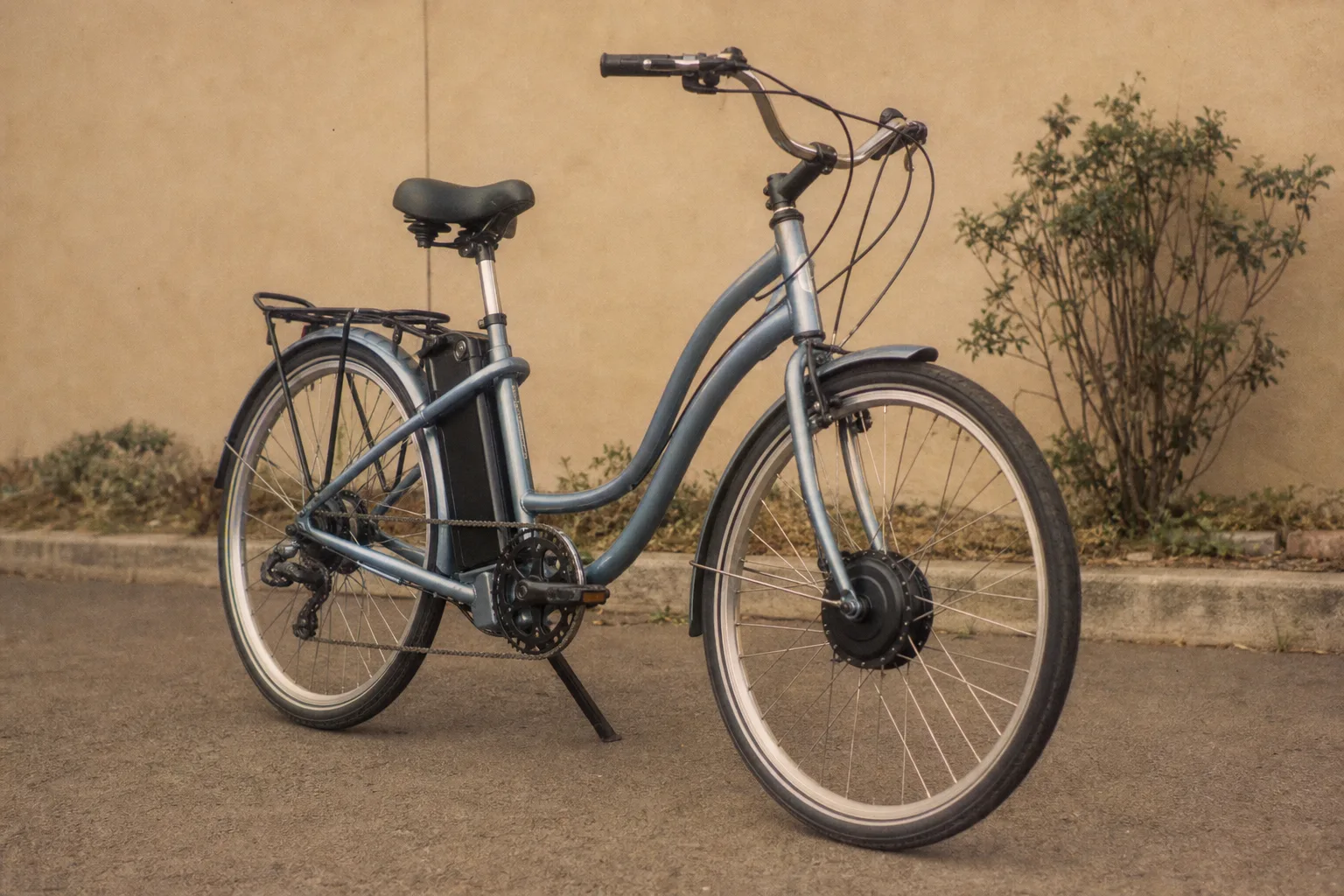
Almost every cruiser-style electric bike sold in the United States leads with a single number, usually 500 or 750, printed next to the word motor. That number is doing less work than it appears to be doing. It describes a continuous rating, it is used to sort bikes into legal classes in most states, and it says very little about whether the bike will pull away cleanly from a stop sign with groceries on the rear rack. A careful reader treats it as one entry among five or six, and reads the rest of the sheet against the riding actually planned.
Nominal watts, peak watts, and which one the law reads
Nominal wattage is the power a motor can sustain without overheating, measured under conditions the manufacturer chooses and rarely publishes. Peak wattage is the brief surge available when the controller allows it, and it is often listed at roughly double the nominal figure, sometimes more. The gap between the two matters because a bike advertised at 500 watts nominal with a strong peak can feel livelier off the line than a 750-watt motor paired with a conservative controller. State vehicle codes, and the three-class framework most of them have adopted, generally reference the nominal figure alone, which means a bike can be legally modest and subjectively quick at the same time. Check both numbers, and note which one the seller led with.
Torque in newton-meters, and where it is felt
Torque is the more useful specification for the way cruisers are ridden, in short bursts between traffic lights on flat pavement with occasional bridge approaches. Figures in the range of 40 to 60 newton-meters are common on hub-drive cruisers, while mid-drive systems frequently publish higher numbers, and the difference shows up in the first two pedal strokes rather than at cruising speed. A hub motor delivers its torque directly at the wheel, independent of the gears, which suits a rider who does not shift much. A mid-drive sends power through the chain and cassette, so a downshift multiplies it, which is why mid-drives climb better on a grade that keeps rising past the point where a hub motor has run out of leverage.
Cadence sensors, torque sensors, and the feel at a stop sign
The sensor decides how the motor answers, and it changes the character of the bike more than any wattage figure. A cadence sensor detects that the cranks are turning and applies a preset level of assist, which produces a distinct surge a half revolution after the pedals move, then a coast when they stop. A torque sensor measures how hard the rider is actually pushing and scales the motor's contribution to match, so the bike accelerates in proportion to effort and settles quietly when the rider eases off. At a stop sign the cadence system tends to lurch and then catch up; the torque system tends to feel like strong legs. Torque sensing usually costs more, and spec sheets that omit the sensor type are typically describing a cadence system.
Throttle, pedal assist, and how the two are specified
A throttle moves the bike without pedaling, which is the practical reason many riders choose a Class 2 cruiser: it covers the awkward moments, a standing start on a slight uphill, a merge, a driveway with a lip. Pedal assist covers the rest of the ride more efficiently, because the motor is sharing work rather than doing all of it, and battery consumption reflects that. Note whether the throttle works from a standstill or only above a walking pace, whether it cuts out at 20 miles per hour as Class 2 requires, and whether assist levels are adjustable in the display. The Consumer Product Safety Commission is the federal body responsible for consumer product safety in this category, and its interest in battery and electrical systems is one reason certification marks now appear on more spec sheets than they did a few seasons ago.
Reading the sheet as a whole
Wattage, torque, sensor type, and control method describe one system, and they are best read together. A 500-watt hub motor with 60 newton-meters, a torque sensor, and a throttle is a different machine from a 750-watt hub motor with a cadence sensor, even though the second looks stronger in an advertisement. Ask what is missing: peak output, sensor type, controller amperage, and gearing are the four omissions that recur. Sellers who publish all of them are usually confident in the answers, and that confidence is itself information worth having before a deposit changes hands.